
Guided Mastery Tutoring
Learners can now be actively tutored through any material. The tutor explains, checks understanding with questions, and only moves on once a concept is understood.

July 27, 2026
What's New
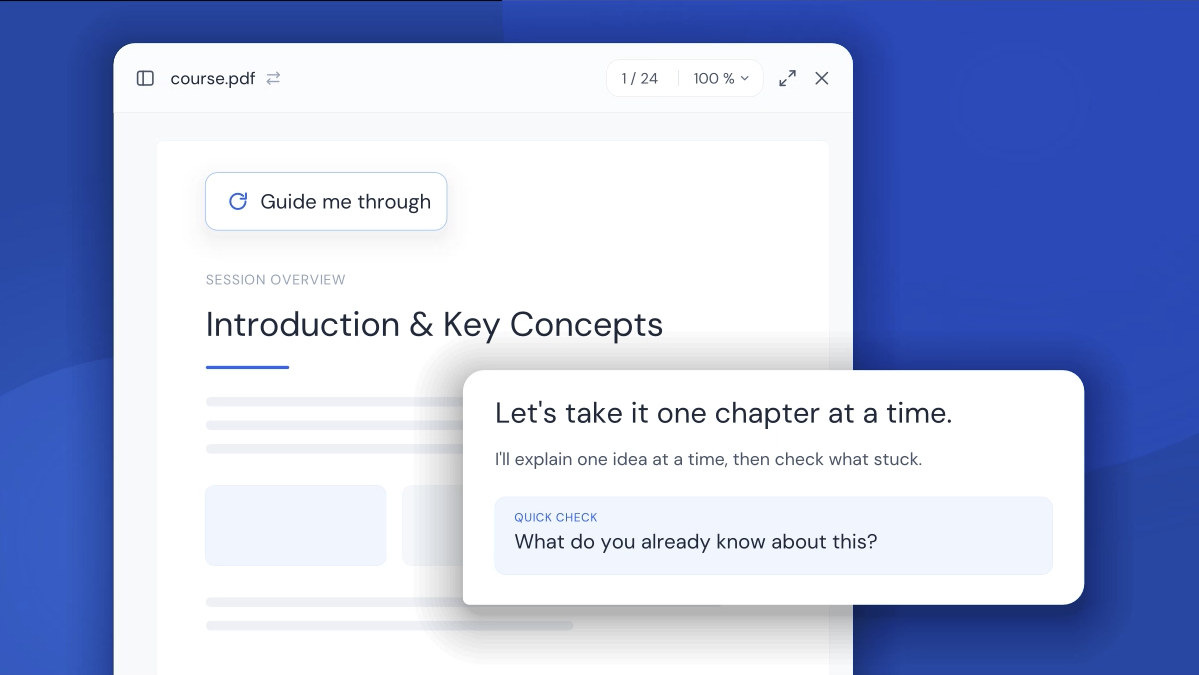
Open any material and start Guide Me Through. Instead of handing over a summary, the tutor works through the content with the Learner, introducing a single idea and then asking the Learner to recall or explain it back in their own words. If the answer is off, the tutor rephrases the question or gives a hint instead of giving the solution.
The course material itself is the syllabus. The tutor stays inside it and says so plainly when a question goes beyond what the material covers.
The Learning Science Behind It
Mastery Learning (Bloom, 1968). Benjamin Bloom's model splits content into small sequential units, closes each one with a check for understanding, and requires mastery before advancing, because moving over an unresolved gap only compounds it. Guide Me Through advances on evidence of understanding rather than on time spent.
Cognitive engagement (Chi & Wylie, 2014). The ICAP framework ranks learning by what the Learner is actually doing: Passive < Active < Constructive < Interactive. Reading a summary is passive. Generating your own explanation is constructive. Doing it in dialogue with a partner who responds to your specific answer is interactive, the top of the hierarchy. Guide Me Through is built to keep Learners in those top two modes for most of the session.
Retrieval, not re-reading (Dunlosky et al., 2013). In a review of ten popular study techniques, only practice testing and distributed practice earned a "high utility" rating. Rereading and highlighting, the two things Learners actually do most, did not. So the tutor asks far more than it explains, and returns to earlier chapters with callback questions as the material progresses.
For Learners
Learners get encouraged to spend their study time thinking rather than re-reading. Because the tutor only advances on evidence of understanding, the essentials get the time they need and familiar ground goes quickly, with no fixed pace to keep up with.
- Active recall instead of passive reading, which is what makes concepts stick
- Adaptive pace: deeper on what's shaky, faster on what you already know
- Callback questions across earlier chapters to ensure you got the basics
For Instructors
Instructors can now give every Learner individual tutoring on their material, at no extra effort. What normally takes one tutor per student happens on its own, on the Instructor's own content, at whatever pace each Learner needs.
References
- Bloom, B. S. (1968). Learning for Mastery. Evaluation Comment, 1(2).
- Chi, M. T. H., & Wylie, R. (2014). The ICAP Framework: Linking Cognitive Engagement to Active Learning Outcomes. Educational Psychologist, 49(4), 219–243.
- Dunlosky, J., Rawson, K. A., Marsh, E. J., Nathan, M. J., & Willingham, D. T. (2013). Improving Students' Learning With Effective Learning Techniques. Psychological Science in the Public Interest, 14(1), 4–58