
Research
Rolling out AI tutors without studying their effects is irresponsible.So we are having ours studied.
AI should strengthen teaching, not hollow it out. Nobody can claim that without evidence, so we publish our own research and let a state institute examine our system independently.
Run by the bidt, not by us
AIffectiveness: an independent study at ten universities.
The bidt was founded by the Free State of Bavaria and sits inside the Bavarian Academy of Sciences and Humanities. It sets the questions, collects the data and interprets the results. We supply the system and the usage data, nothing else.
First results
Summer semester 2025. Data collected and analysed by the bidt research team.
How the data is collected
Not whether AI works, but where it works and where it does not. In real courses, not in a lab. Every semester follows the same rhythm.
Before the course
Baseline survey
Students answer inside OneTutor before they start working with it.
During the semester
Usage data
Anonymised interactions from large lectures and small seminars alike.
End of the course
Follow-up surveys
Students inside OneTutor and in class, lecturers separately by email.
After the semester
Analysis and publication
The bidt evaluates, publishes, and the cycle starts again with the next cohort.
What is measured
Learning effectiveness, engagement, exam preparation and teaching feedback, plus how trust in AI develops over time.
What gets published
Everything the study finds, including the results that do not favour us.

I hope that by the end we will understand exactly where these systems are useful and where they are not. It is not just about whether it works, but in what context: large lectures versus small seminars, or fact based disciplines versus argumentative ones.
Prof. Dr. Alexander Pretschner
Chair of Software and Systems Engineering, Technical University of Munich. Scientific Director, fortiss. Founding director of the bidt. Co-founder and Chief Scientific Officer, OneTutor.
Participating institutions






Related articles & news

An AI Tutor Goes to Class: First Results
A new study examines how students and instructors at ten Bavarian universities experienced OneTutor during the summer semester 2025. Most instructors see it as a useful addition to their teaching, while students primarily use it for exam preparation.
Summer 2025: first evidence on AI tutors in higher education
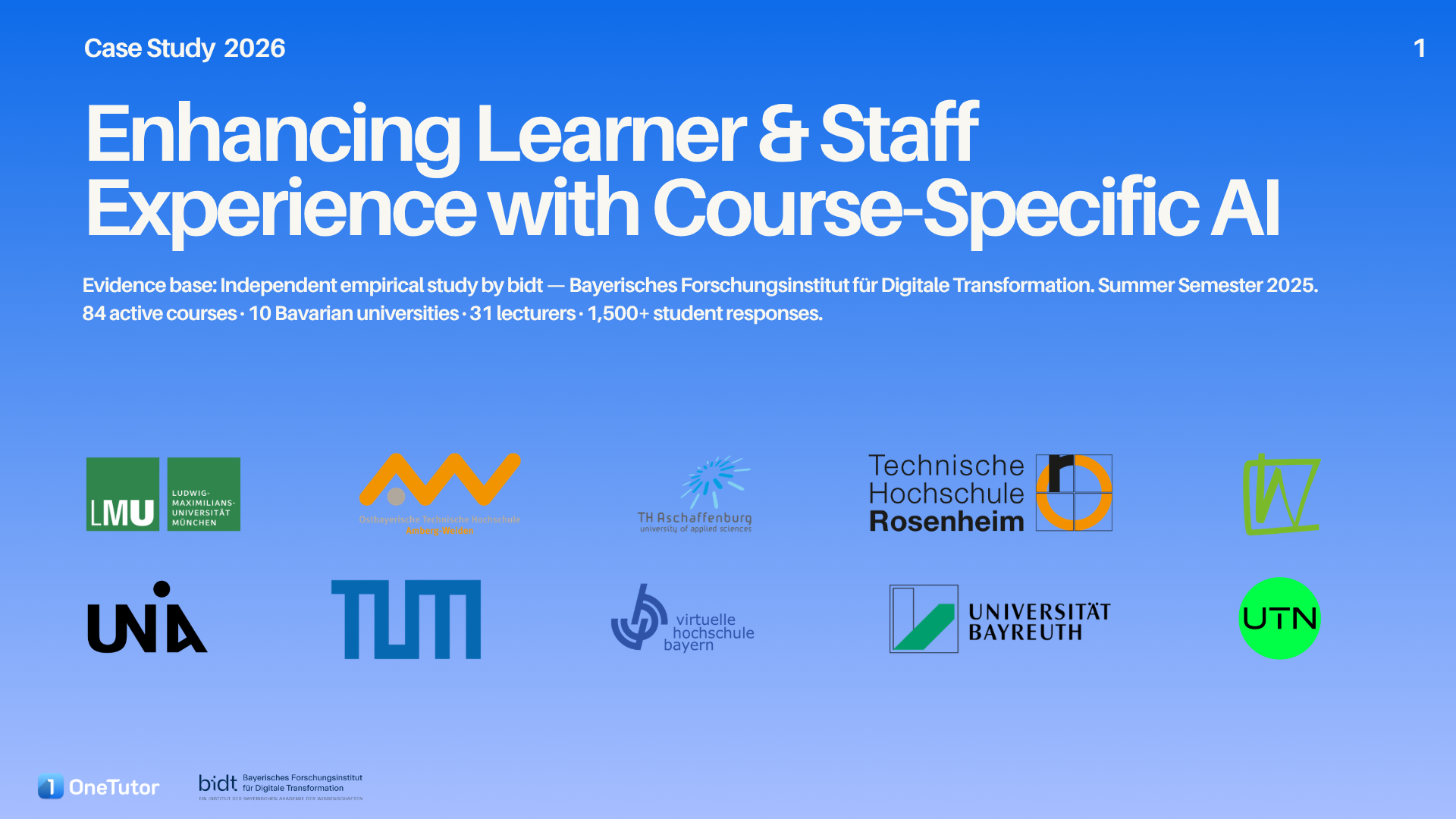
84 courses at 10 Bavarian universities, 31 lecturers and more than 1,500 student responses. The full case study covers the methodology, the satisfaction metrics and what these early findings mean for AI in higher education.
“We want to understand where AI tutors can be put to good use”
Alexander Pretschner on the development of OneTutor and its role in higher education: how AI can assist lecturers, how it personalises student learning, and why evidence matters more than claims.

Bavaria becomes a real-world laboratory for AI in teaching
Ten Bavarian universities are partnering with the bidt to test AI in lecture theatres. The project investigates the actual learning success of OneTutor in real educational settings, instead of speculating about it.