
Behind the OneTutor Learning Report: why and how we built it
Why we publish the OneTutor Learning Report, how we built it from 628,000 student messages at 32 universities, and what it cannot tell you yet.

After reading this article you will know three things: why we built the OneTutor Learning Report, the methodology behind it, and what we plan to do with it next.
First, who we are. OneTutor gives instructors the tools to shape how their students use AI while they learn. It works in three steps.
- Set up. Instructors turn their own course material into an AI tutor for their students.
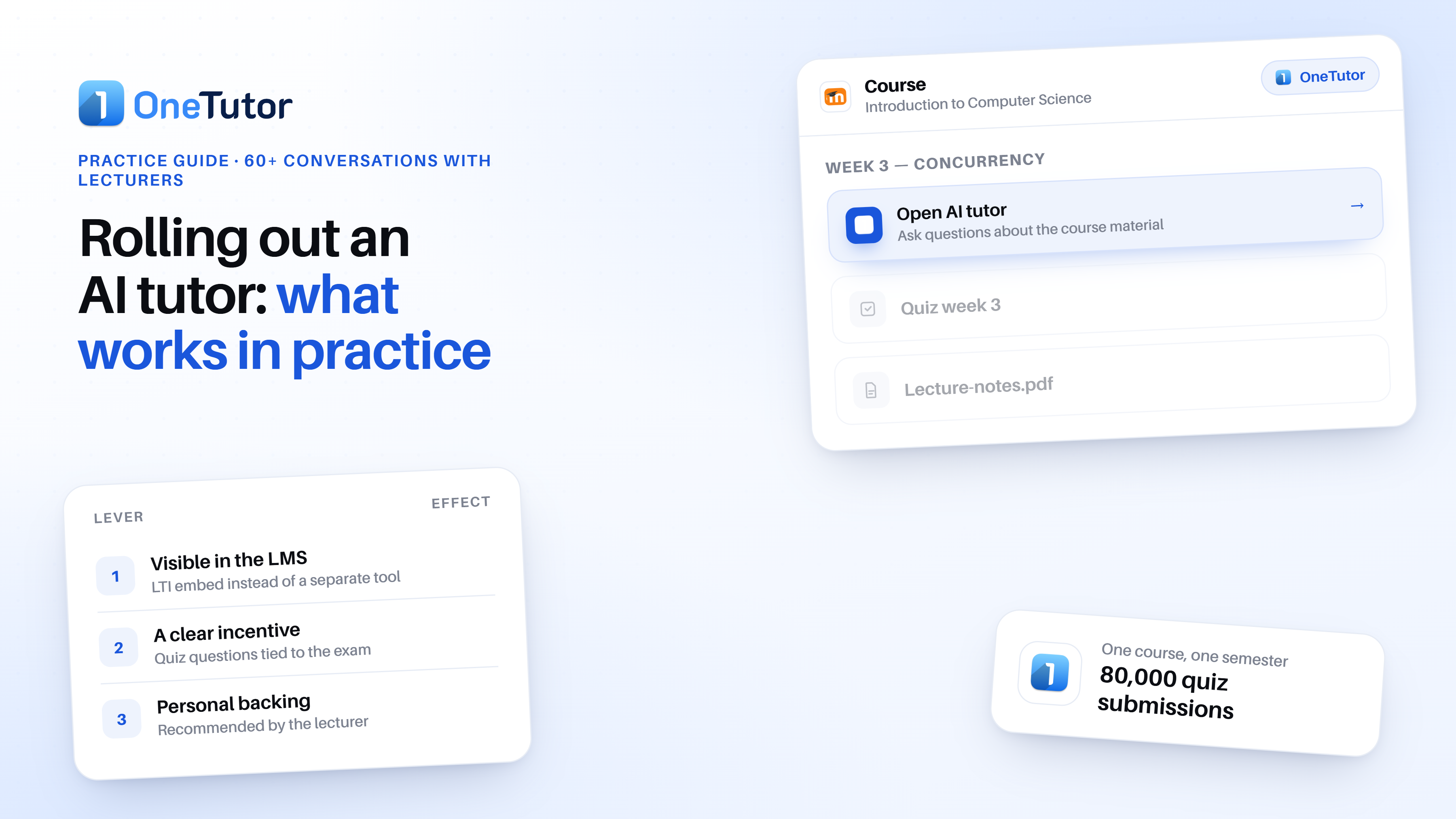
- Practice. They add quiz questions for formative assessment. After answering, students can ask with one click why their answer was right or wrong. That click sends a message to the tutor, which is why quiz feedback shows up in the report.
- See. Instructors see how their students study: the questions they ask and the answers the tutor gives.
Instructors usually cannot see what their students do with AI. With a tool like OneTutor, they can.
OneTutor is used at more than 50 institutions: universities, private academies and companies. This first report covers only universities and universities of applied sciences, whose courses share a similar rhythm and similar learning goals. Adding corporate training would mean comparing apples and oranges.
You can read the report itself at onetutor.ai/learning-report. This article is the story behind it.
Why we publish it
Less struggle is a paradox
Since ChatGPT arrived in November 2022, learning has become one of the main reasons people use AI. The benefits are obvious: AI is available at any hour, adapts to each student and takes the struggle out of studying.
That last benefit is a paradox. Less struggle can help a student grasp a new concept, and it can quietly take over the thinking that learning depends on. In a field experiment in high school math, students with unrestricted access to GPT did 48% better on practice problems but 17% worse in the exam. A tutor version with guardrails largely avoided the harm (Bastani et al., PNAS, 2025).
Not whether, but how
So the question is not whether students use AI, but how. Does a student hand over the thinking, copy an answer and feel good about ticking off a chapter? Or does the student reflect on their own thoughts, challenge their progress and find the process hard? That is what this report tries to find out. We want to understand how students interact with an AI tutor at university, which use cases dominate, how usage changes over a semester and how it differs between academic disciplines.
Our position
We do not think the answer is to keep AI out of studying. Students will learn with AI either way. If universities restrict it, the same habits simply move to private chatbots, where nobody can see or shape them.
Receiving an explanation is also a normal part of learning. Simple questions often come first, and deeper ones follow. The problem starts when handing over the thinking becomes the only thing students do. We therefore see our task in shifting the learning time students invest from weak methods to strong ones. This report is how we check whether that happens.
Why we share it publicly
We look at this data to understand the status quo, and we want it to be the basis for decisions on how AI should be used for learning. We believe the effectiveness of AI in learning has to be evaluated, so that the learning process can be steered toward the benefits and away from the risks.
By sharing what we find and how we read it, we want to offer a perspective and open a constructive discussion with everyone who is rethinking their teaching.
How we built it
The data
We classified all 628,000 anonymized student messages from the winter semester 2025/26 and the summer semester 2026 at 32 universities and universities of applied sciences in Germany, Austria and Czechia. There is no sampling. Demo and test accounts, schools, companies and training providers are left out.
Four guiding questions
Four questions guided the analysis. Each one has its own section in the report.
- When do students use AI to study during a semester?
- How do academic disciplines differ in how they use it?
- What do students use AI for while studying?
- Who does the cognitive work: the student or the AI?
Weeks and academic disciplines
To make the semesters of different universities comparable, we count weeks from each university's own lecture start. The count runs on through breaks and exams.
To find out which academic discipline students learn in, we used the name of the course. A language model assigned each course name to one of thirteen academic disciplines: Law, Business and Economics, Social Sciences, Psychology, Education, Humanities and Languages, Mathematics, Computer Science, Natural Sciences, Engineering, Medicine and Health, Agriculture, Food and Life Sciences, and Public Administration. Interdisciplinary courses count in the totals but get no row of their own.
To protect courses and institutions, a value is only shown when at least 5 courses, 2 institutions and 500 messages stand behind it.
Eleven request types, one question
To tell what students actually do, we defined eleven request types. A language model sorts each message into one of nine of them, using a fixed coding guide built around one question: does the student or the AI do the thinking? Two types come from fixed rules instead: clicks on the quiz feedback button always count as “ask why a quiz answer was right or wrong”, and answers to the tutor of at most 30 characters without any reasoning become “give a short quiz answer”. Empty messages count as no learning request. We then group the types into four, following the ICAP framework:
- Students think (ICAP: interactive or constructive): check an own solution, answer the tutor with reasoning, ask a targeted question.
- Practice (ICAP: active): give a short quiz answer, ask why a quiz answer was right or wrong, ask to be quizzed.
- AI thinks (ICAP: passive): ask for an explanation, look up a fact, have a task solved, have material created.
- No learning request: greetings, thanks, organizational or technical questions.
The line between two types is often fine. Take “ask for an explanation” and “ask a targeted question”. “Explain the difference between mitosis and meiosis” asks for an explanation: the student adds no thinking of their own. “Why is Δ negative here if the temperature rises?” is a targeted question: the student has noticed a contradiction and points to it. The prompt with all category definitions and examples is at the end of this section.
Why ICAP and not Bloom
We tried Bloom's taxonomy first and dropped it. Based purely on the content of a single message, it is hard to identify the right Bloom level. A short request like “make me a quiz” would land on the top level, create, although the student creates nothing. The four ICAP levels (Chi and Wylie, Educational Psychologist, 2014) are much easier to tell apart: does the student bring their own thinking, practice, take in what the AI produces, or make no learning request at all?
Courses with and without quiz questions
To see what quiz questions add to open chat, we compared courses by how much their students used quiz feedback, the button that asks the tutor why a quiz answer was right or wrong. We counted courses without a single quiz feedback message as chat only, and courses where quiz feedback makes up at least 5% of all messages as quiz courses. Courses in between form a third group. Only courses with at least 200 messages are included: 373 courses with 605,332 messages.
- Chat only (104 courses, 161,006 messages): 31% active learning (students think or practice), the AI does the thinking in 59%.
- Some quiz feedback, under 5% (58 courses, 115,918 messages): 31% active learning, the AI does the thinking in 61%.
- Quiz courses (211 courses, 328,408 messages): 44% active learning, the AI does the thinking in 48%.
Typed chat messages, without the quiz button, look alike in all three groups: the AI does the thinking in 59% to 63% of them. Quiz questions add practice on top of the chat; they do not change how students chat. Within academic disciplines the picture holds: in 8 of the 9 disciplines with at least three courses in both groups, the active share is higher in quiz courses. Law is the exception, with no difference.
Three caveats. We see quiz use through the feedback button, not whether a course offers quiz questions at all. The comparison is observational: instructors who set quiz questions may also teach differently in other ways. And one click on the quiz button is one message, so these are shares of messages, not of learning time.
How this compares to other studies
Our data covers one AI tutor inside university courses. Other studies look at general chatbots or at learning outcomes. Taken together, they point in the same direction as this report: what matters is how AI is used.
Learning is one of the main uses of AI. 10.2% of all ChatGPT messages ask for tutoring or teaching, in a sample of about 1.1 million conversations from May 2024 to June 2025 (Chatterji et al., How People Use ChatGPT, OpenAI, September 2025).
Bloom describes the AI, not the student. Anthropic's education report rated Claude's answers in student conversations by Bloom's taxonomy: creating (40%) and analyzing (30%) came out on top. The authors note that this describes the AI's work, one more reason why we rate who does the thinking instead. They also found nearly half of the conversations to be direct, aimed at getting answers or content with little engagement. The method and the unit differ, but open chat in OneTutor looks similar: in 62% of typed messages, the AI does the thinking. The difference comes from what instructors add around the chat, such as quiz questions (see above). In their data, computer science made up 39% of student conversations, against 5% of US bachelor's degrees. In our data, the mix of academic disciplines mostly follows which instructors brought the tutor into their courses (Anthropic Education Report: How University Students Use Claude, April 2025).
Guardrails matter. In the high school math experiment mentioned above, students did 48% better on practice problems with unrestricted GPT but 17% worse in the exam once access was gone (Bastani et al., Generative AI without guardrails can harm learning, PNAS, 2025).
Our framework. ICAP (Chi and Wylie, 2014) is the lens for everything above. Our view on AI tutors in teaching is in the OneTutor whitepaper.
The classification prompt
This is the prompt the language model received (version usage-v1), shortened to the task and the category definitions with their examples. We left out the decision rules for borderline cases and the technical input and output format. It ran on OpenAI's gpt-6-luna through the EU endpoint, with 25 messages per request and each message cut to 1,500 characters. The categories quiz_explain and answer_short do not appear in it, because they come from the fixed rules described above.
You classify student messages sent to a university AI tutor.
Usage coding guide (usage-v1)
Classify each student message to an AI tutor by what the student is doing with the tutor, judged from the message alone. The key question is: who does the thinking in this message, the student or the AI? Judge what the student contributes, not how hard the requested AI output would be to produce. Pick exactly one category.
Categories
- own_work_check: the student presents their own attempt (solution, result, answer, code, text, argument, outline) and wants it checked, corrected or explained. Also: "I answered X, why was that wrong/right?". Examples: "Ich habe x = 4 raus, stimmt das?", "Here is my code, why does it fail?", "Ist meine Argumentation zu § 823 BGB so richtig?", "Kannst du mir Feedback zu meiner Gliederung geben: …".
- answer_to_tutor: the student answers a question or task the tutor posed (quiz mode, Socratic dialogue), without asking for anything else. Often short. Examples: "B", "42", "Ich glaube, weil die Nachfrage sinkt", "Die Zellmembran ist semipermeabel, deshalb …".
- targeted_question: a question about the subject that contains the student's own thinking: a hypothesis, an observed contradiction, a comparison with their own understanding, or a precisely located point of confusion. Examples: "Warum ist Δ hier negativ, wenn die Temperatur doch steigt?", "Heißt das, dass jeder Verwaltungsakt auch eine Regelung ist?", "I thought recursion needs a base case, why does this one work without?".
- practice_request: the student asks to be quizzed, tested or given practice questions or exercises to work on themselves. Examples: "Frag mich zum Thema Enzyme ab", "Give me 10 practice questions on chapter 3", "Stell mir Übungsaufgaben wie in der Klausur".
- explanation_request: the student asks the tutor to explain, summarise in words, compare or give examples, without adding their own thinking. Examples: "Erklär mir den Unterschied zwischen Mitose und Meiose", "Can you explain how a transistor works?", "Was bedeutet Opportunitätskosten?" when an explanation is wanted.
- fact_lookup: the student wants a single fact, definition, formula, date, number, list or rule. Examples: "Formel für kinetische Energie?", "Was steht in § 433 BGB?", "What is the half-life of C-14?".
- task_solving: the student hands over a task, exercise or exam question for the tutor to solve, with no own attempt. Includes a pasted task without any request. Examples: "Löse dieses Integral: …", "Berechne den Kapitalwert für folgende Zahlungen …", "Prüfe den Fall: A verkauft B …".
- material_request: the student asks the tutor to produce learning or study material or text for them: summaries, notes, flashcards, an essay, a translation, a rewrite. Examples: "Fass Kapitel 2 für mich zusammen", "Schreib mir Lernkarten zu Kapitel 2", "Formuliere diesen Absatz wissenschaftlicher".
- no_learning: no learning request: greetings, thanks, "ok", "yes", "weiter", organisational questions (exam dates, rooms, grades), technical problems, questions about the tutor itself, empty or unreadable messages.
What the report can't tell you yet, and what comes next
Five limits of this edition
This first edition has clear shortcomings. We publish it anyway, because it is a good starting point for a conversation, and we will improve it with every edition.
- A few places shape the totals. The five largest universities send 82% of all messages, and the ten largest courses almost a quarter (24%). Within courses, a smaller group of very active students sends many of the messages.
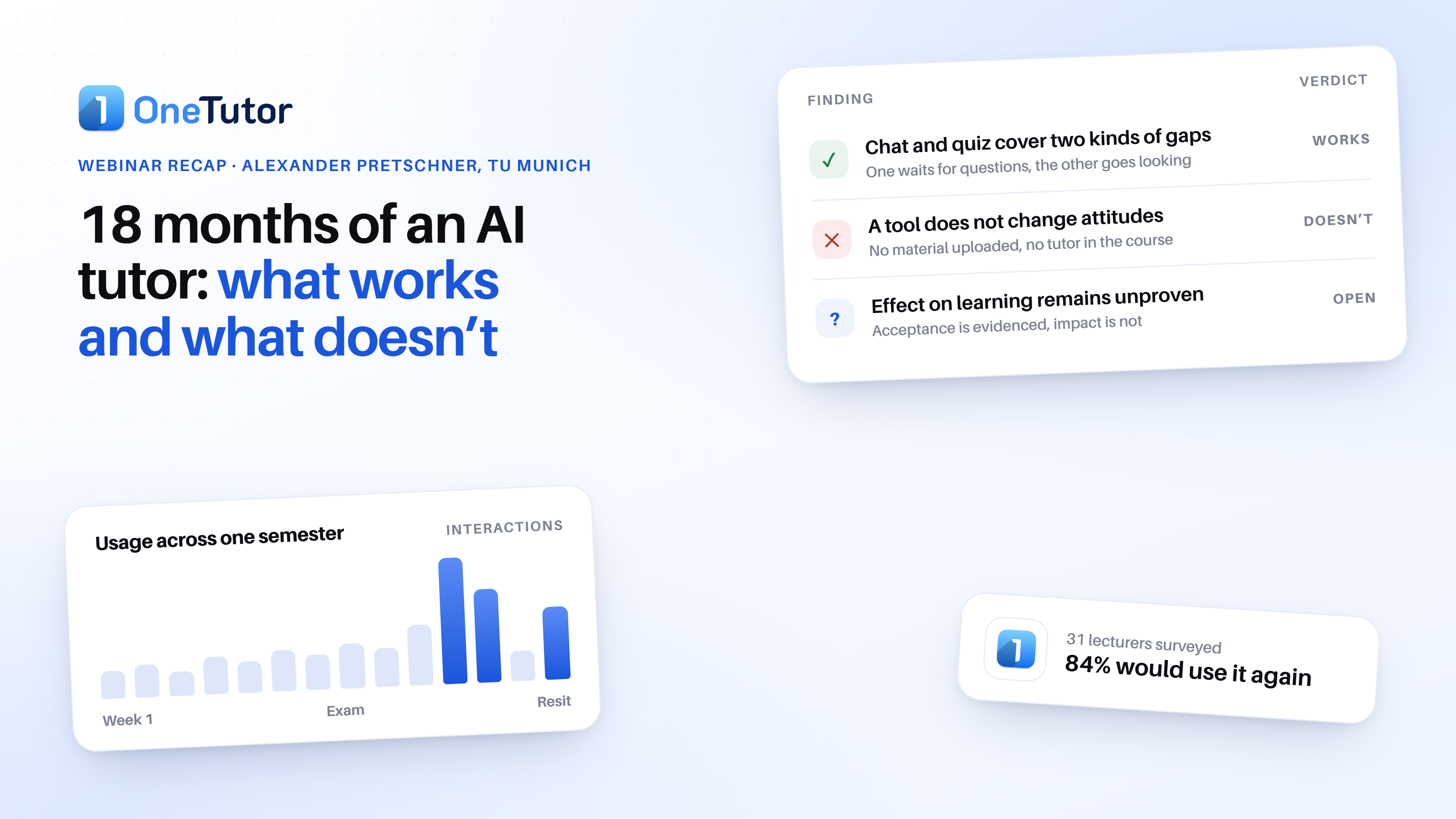
- No learning outcomes yet. We see how students use the tutor, not whether it improved their understanding or their grades. The accompanying research by the bidt on the use of OneTutor in the summer semester 2025 shows how hard this is: it found no difference in perceived learning success between frequent users, light users and students who did not use the tutor, and exam results could not be linked for data protection reasons.
- Only one side of the conversation. We classify what students write, without the tutor's replies. Real back and forth is therefore likely undercounted.
- AI labels are not perfectly reproducible. A language model sorts every message using a fixed coding guide. A second run would label some messages differently.
- Quiz results are not included yet. How students perform on quiz questions is one of the next data points we want to add.
What comes next
We will publish this report every semester to follow how the use of AI in teaching and learning develops. We also want to measure better: quiz performance, the tutor's replies and, where possible, learning outcomes.
The results give us two directions for OneTutor, both about shifting learning time from weak to strong methods. First, open chat on its own invites students to ask for answers, so we want to add more structure that makes students think first. Quiz questions point in that direction: in courses that use them, 44% of messages are active learning, against 31% in courses that do not. Second, that practice clusters around the exams, so we are looking for ways to keep it going through the whole semester.
Tell us where we read it wrong
This edition is a starting point, not a verdict. Dissect our approach, question our readings and tell us what we missed. The goal is to find out together how and when AI improves learning and teaching. You can write to us here.
If you want the next edition first, subscribe to our newsletter. A new edition comes every semester, with what changed since the last one.
Latest
From the blog
Insights on AI in teaching and learning, from research and practice.
View all posts