

How AI Complements Higher Education: Insights from the OneTutor Project at TH Rosenheim

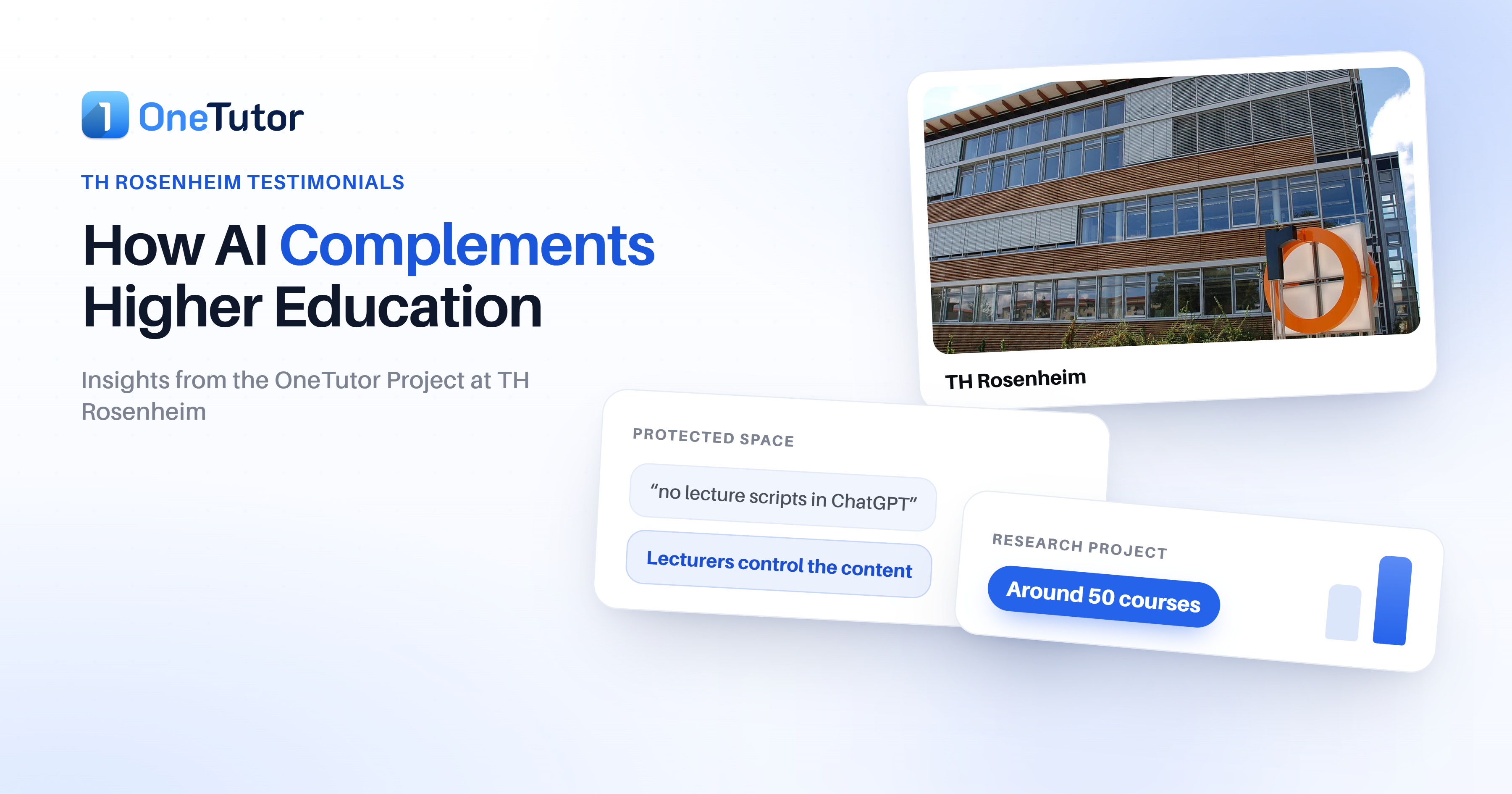

AI has long arrived in universities. Students are already using AI-Chats like ChatGPT anyway, with or without guidance. Therefore, the exciting question for universities is no longer whether AI plays a role in teaching, but how it can be used meaningfully. the Technical University of Applied Sciences Rosenheim (TH Rosenheim) is investigating this question in a research project in which OneTutor is being scientifically monitored and tested as a learning platform. Meanwhile, more than 40,000 students are learning with OneTutor. Three lecturers from TH Rosenheim report on what this looks like in practice.
A Research Project with Around 50 Courses
Holly Ott is a Professor of Production Management at the Faculty of Wood Technology and Construction. She has accompanied the use of OneTutor at TH Rosenheim from the very beginning: "It is very important to us to stay on the ball when it comes to AI. OneTutor offered us the interesting opportunity to be part of a research project. We have now been working with the tool for about a year and have had around 50 courses in various semesters so far."
This creates a broad picture: Which courses work well, which ones less so, and how does the tool develop over time? Ott finds the students' reactions particularly insightful.
"Students appreciate getting guidance. With OneTutor, we can easily give them additional tasks to work through. And we see that they use the tool intensively right before exams."
— Prof. Holly Ott, TH Rosenheim
A Protected Space for Teaching Materials
Meike Töllner, Professor of Structural Engineering, teaches structural concrete, steel construction, and glass construction. For her, data protection was the decisive reason for using OneTutor: "I don't want students uploading my lecture scripts to ChatGPT. They are not even allowed to upload copyrighted documents there anyway. That's why I am very grateful for this closed space where I can practice with them how to use AI meaningfully for the subject."
Her courses have between 30 and 80 participants. Especially in large groups, she sees an effect that classic lectures can hardly achieve:
"With 80 people, I simply bring along those who would otherwise remain silent. I wouldn't see anything of them otherwise. When I pick out a prompt and say that it is particularly good, they feel addressed much more personally."
— Prof. Meike Töllner, TH Rosenheim
Structure Instead of Uncontrolled AI Use
Felix Höpfl, Professor of Personnel Management, Leadership, and Organization in the Healthcare Industry, has been researching language models himself for years. His observation: Students use AI anyway, but without structure and without checking the results. "That's why I was very glad when the option came along to introduce a system with OneTutor where I, as a lecturer, can intervene to control the content."
For him, this is precisely the key difference compared to freely available AI tools:
"I exceptionally like that OneTutor focuses on the teaching content I provide and then delivers a very well-structured response that is professionally and linguistically sound. I can be sure that the teaching content is taken into account and that the wild, free internet does not rule."
— Prof. Felix Höpfl, TH Rosenheim
Which Subjects Are Suitable for an AI Tutor?
Initial patterns can be identified from around 50 courses. Holly Ott summarizes the feedback from lecturers as follows: "Foundational subjects like physics, statistics, or quality management, meaning subjects with many definitions, work very well. The students love it and work really well with it." In calculation-heavy subjects like production management, she reviews generated quiz questions before releasing them, but uses them as a ready-to-go working basis.
Felix Höpfl adds from the perspective of health and social sciences: "Wherever it becomes language-heavy, where it's about interpretations, business cases, legal texts, or different perspectives, OneTutor has shown great performance. The course size is irrelevant; it works in very large as well as very small groups."
Conclusion: AI Teaching Needs a Framework
The experiences at TH Rosenheim show: The added value of AI in higher education arises when lecturers control the content and students can learn in a protected space. This is precisely what OneTutor delivers, from foundational subjects to language-heavy seminars. How lecturers specifically integrate the tool into their didactics and what impact this has on exam results can be read in the second part of this series.